
Wallriders
Roles
Brief Summary
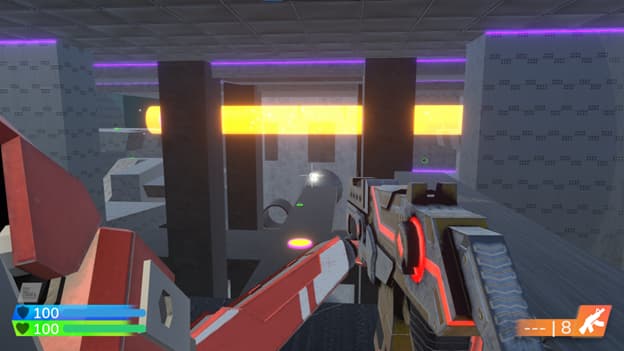
Wallriders is an online multiplayer first person shooter that hosts up to 4 players fighting in an arena for the first to win 10 points.
I worked on this team for over the course of 8 months with a team of 6 people in the first half of development and 5 people in the second half.
I came up with the idea for this project and proposed it to my peers until I managed to bring together a team of great game developers. My roles in the project were gameplay designer, level designer, system designer, producer, and playtest conductor.
The Gameplay
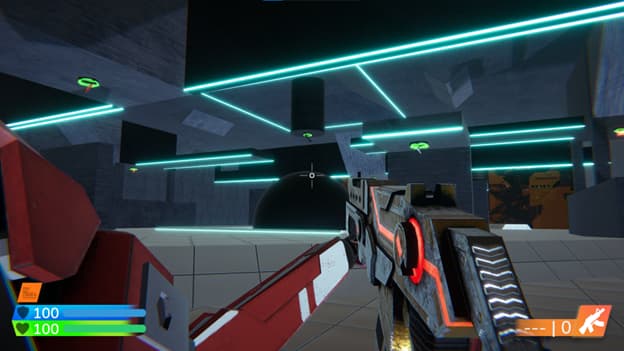
My goal with this game was to design an experience where players had the unique ability to walk on walls and on the ceiling. This presented challenges for how was going to design the player controls and the levels. For example, “How do we address players getting disoriented by walking onto new surfaces?” and “What ways can we best utilize the mechanic through the level design?”
The Controls
Before starting, I knew it would be challenging to develop controls for walking on walls that were accessible and gave players the most amount of control possible. My first idea for going about the controls was to automate the wall walking so that it required as little thinking on behalf of the user. We created the first player controller to have players walk up walls automatically when touched. We then also made it so players could simply return to the default gravity by jumping. In our first run of testing, we found that players liked that it was easy to start running on walls but they did not like it when they went on walls they weren’t expecting to go on. This would often happen when they backed into the walls. At first I considered the idea of having players jump to go on walls but I knew this would make wall walking less desirable since players would have to think about it more and it would be harder to understand.
The next idea I came up with was to make it so players couldn’t back into walls. By doing so, I determined that players would then have to be deliberate in wall walking by seeing the wall they walk on. This turned out to work rather well since players did not try to walk backwards into walls to start wall walking anyways.
On the side of detaching from walls, at first I decided to test having the players detach from walls simply by jumping. The intent was to make it easy and comprehensive to detach from walls. What I found was that while players easily understood detaching, they discovered quickly that it was not optimal to jump on the walls or ceiling since it would always result in them returning to the ground. This made players feel their mobility was limited on walls and ceilings, so they began to avoid utilizing the wall walking mechanic. In light of this, the next iteration was updated so that the player would press the jump button again in mid air to detach from wall walking and fall to the ground. This essentially gave the player control over whether their jump would bring them to the ground or not and increased the players mobility while wall walking. When we tested this, we found that players were more likely to utilize the walls and ceilings to their advantage since they had greater mobility while wall walking then when not wall walking.
The Levels
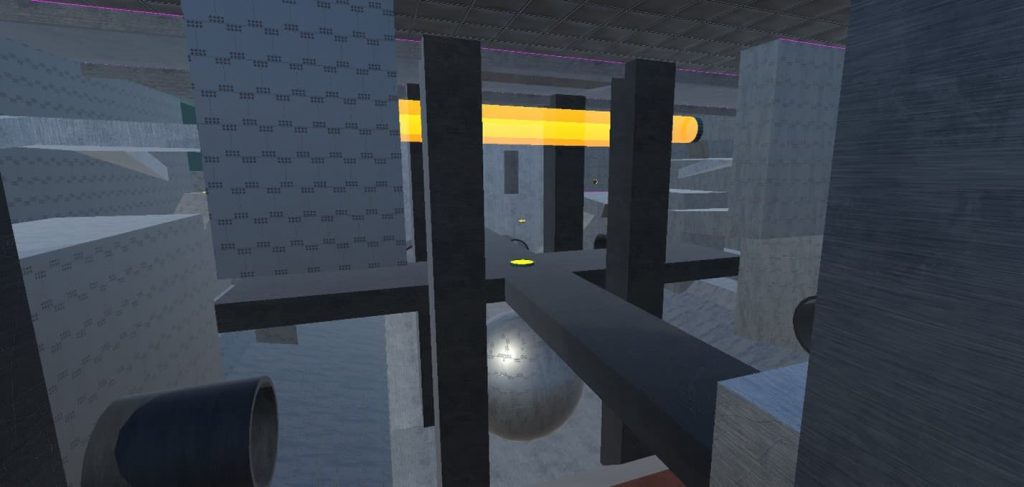
Using color and texture, simple geometry, going into this project, I was aware of two major hurdles I’d need to tackle in the development of this project. The first was “How do I make the levels comprehensive to play in real time?” and “How do I make the most use out of the wall running mechanic in the level design?” For the first question, I settled with the idea that I would keep the level geometry simple and use colors and textures to assist with making the levels more readable during gameplay. By keeping the geometry simple, I kept removed any necessity to force the player controller to compensate for strange or otherwise sudden small variations in elevation. In terms of colors, I worked with my fellow designer to determine a rough color palate for the game that we would follow. Using it, I was able to lay add color to the levels so that players could better decipher their surroundings when compared to the early white boxed prototypes.
To tackle the second question of how to make the most use of the wall walking mechanic, I first stuck with a principle that every level would have a ceiling to access and that the ceiling would host some valuable item to encourage wall walking. When going about the first level of the game, I started by making something that wasn’t too different from the kind of level you’d see in a standard first person shooter. The one major thing I tried to do differently was to make the ceiling like its own floor. That way, the gameplay on the ceiling and ground would be similar but unique. This helped make the first level a sort of unofficial tutorial level while also allowing for a good Wallriders experience.
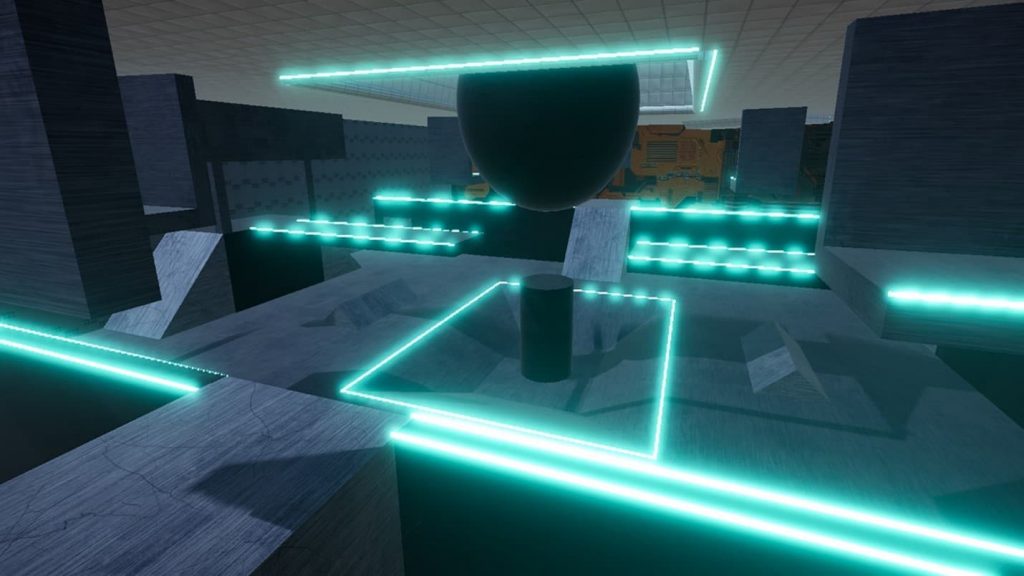
In the second level, I aimed to be much more ambitious. I started with Super Mario Galaxy’s level design as my inspiration. I wanted to make a level that heavily utilized jumping from planetoid to planetoid, and to experiment with some more unusual but still simple shapes. The initial result was unplayable. I learned from simply playing the level myself that it was far too difficult to run around a planetoid while still keeping steady aim on a target. I realized that I needed to cut down on their use in the level. After restarting with a new design, I tested the level again. The new design was playable but was too big, felt mostly vacant, and many areas of the map were never played in.
I decided to shrink the level down again and adjust the design further. I removed all but a few spheres since players hated playing on them. I then introduced many new routes that interconnected the level further and added new structures to the level that provided cover. This new design turned out to be more successful than the first level by having more verticality than the first level and even more cover for players to find tactical advantages. The wall running is greatly utilized as players use the mechanic to take short cuts in traversing the level and grabbing new weapons.
The Weapons
I also desired that the game host a variety of weapons, each with a unique role in the weapon sandbox that was relevant and enjoyable. I brought the whole team together for us to brain storm the weapons sandbox. We created a large list of weapons then cut it down to what we thought the best 9 were. After half way through development, we realized we didn’t have the bandwidth to develop 9 weapons so we cut down to 5. We knew we wanted each weapon to be unique and fill a distinct role so we made some categories. We needed a default weapon that is good in most situations, a close range weapon that kills quick up close, a general power weapon, a high powered long ranged weapon, and a weapon with a “bizarre or fun mechanic.” We started by filling the first four weapon types with rather standard weapons for such categories (machine gun, shotgun, rocket launcher, and railgun). I wanted to make each weapon a bit more unique, so I proposed the idea of having each weapon use a primary and alternative fire.
This opened the gateway for each of the 5 weapons to fit their standard roles in the weapon sandbox and to also have another function that complimented their main function. With this idea in mind, we also came up with the last idea for a weapon in the sandbox, the security pistol.
Here are the weapons in the game with their primary and alt fires explained:
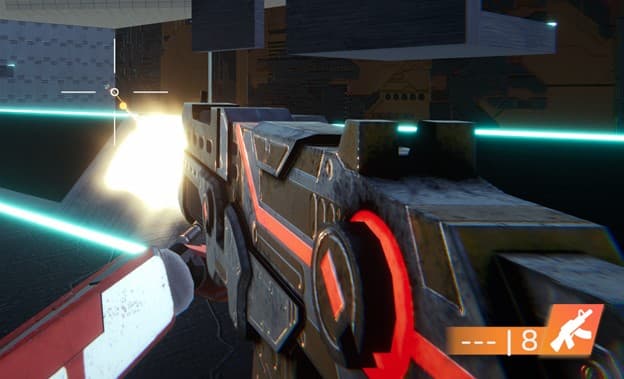
Machine Gun
- Primary fire: Standard automatic fire
- New Alt Fire: Grenade
- Fires a grenade in an arc. Smaller AOE than a rocket and less damage. You get more grenades by dealing damage with the primary fire.
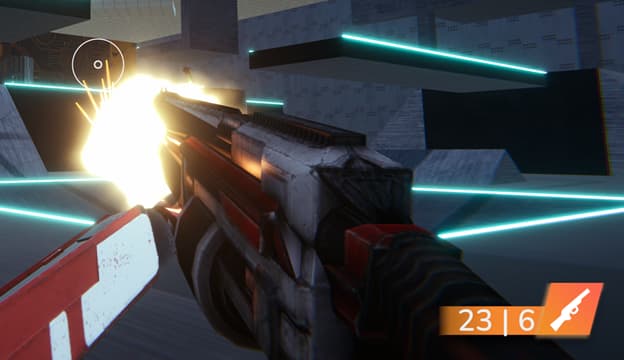
Shotgun
- Primary fire:
- When on the ground, you launch players far away
- When in the air, you launch yourself away from where you’re aiming
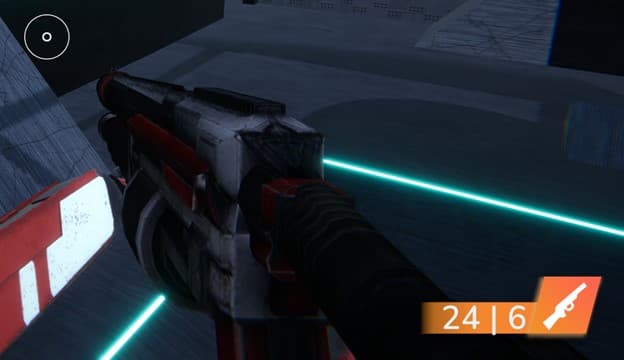
- New Alt Fire: Teleport shot
- The player fires a single shot. Once that shot hits a surface, the player will teleport to it. This changes the player’s gravity to the gravity of the surface they land on.
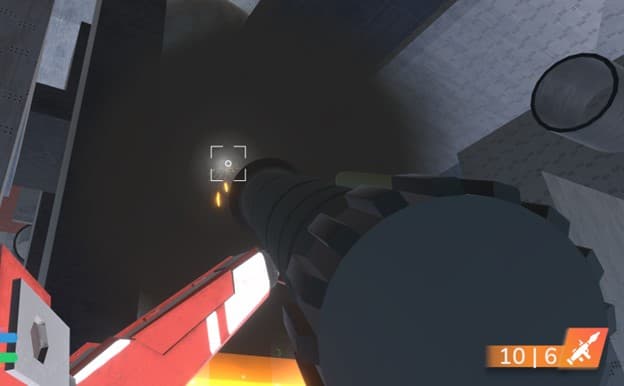
Rocket Launcher
- Primary fire: shoots a rocket
- New Alt Fire: Black hole
- Fires a shot that implodes upon impact. The blackhole will remain for about a second, holding in place whatever gets caught in its grasp. The shot is slower than a rocket though.
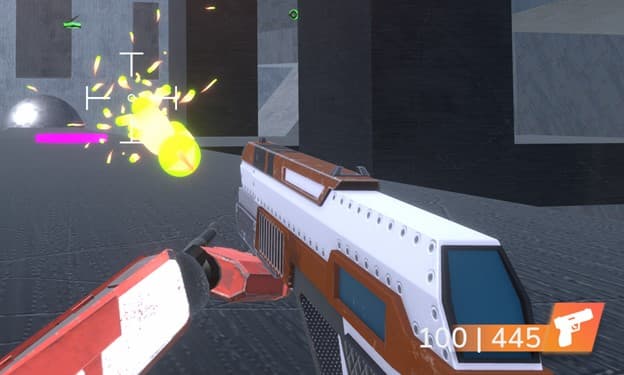
Security Pistol
- Primary fire: High-speed bullet, all secondary fire bullets home to where the first shot went
- Alt fire bullets home in on the next primary fire bullet you shoot
- New Alt Fire: Slow Bullet
- Fires the slow bullet. When the primary shot hits a target, these slow bullets will turn and begin to move at an unavoidable speed. They cannot go through walls.
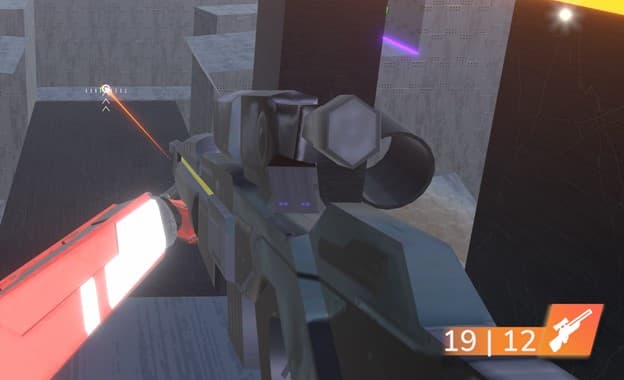
Railgun
- Primary fire: Ricocheting laser beam
- New Alt Fire: Area Denial Shot
- Fires a ricocheting laser that does less damage but leaves behind a mist that expands and falls, quickly accumulating damage on enemies. The player firing naturally is not damaged by this mist.
Contact Me
If you’re interested in working with me, contact me via email at [email protected].
You can also download my resume here.